
UPI has made digital payments extremely convenient, but sometimes a transaction can fail even after money has been debited from your bank account. This can be confusing, especially when the payment status shows failed, pending, or declined while the amount has already been deducted.
The good news is that a failed UPI transaction does not necessarily mean that you have lost your money. Depending on the type of transaction and where the failure occurred, the amount may be automatically reversed or refunded.
This guide explains how to get a refund for a failed UPI transaction in India, what to do when money is debited but the payment fails, and how to raise a complaint if the refund does not arrive.
What Is a Failed UPI Transaction?
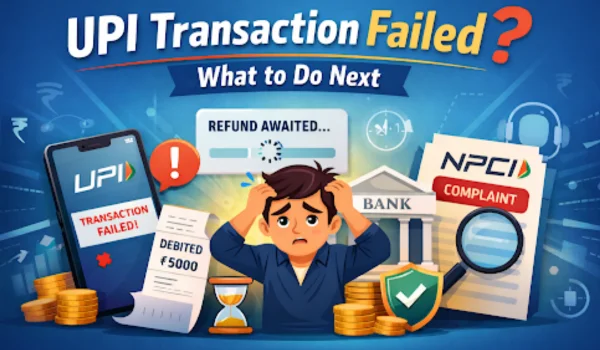
A UPI transaction can fail for several reasons, including:
- Bank server issues
- UPI network problems
- Incorrect UPI PIN
- Insufficient balance
- Technical problems with the payment app
- Bank account issues
- Temporary connectivity problems
A failed transaction is different from a successful transaction. You should first check the transaction status in your UPI app before trying to make the payment again.
What Happens If Money Is Debited but the UPI Transaction Fails?
If your account has been debited but the transaction has failed, the amount is generally subject to reversal according to the applicable payment-system rules.
NPCI’s UPI guidance states that where a failed or pending transaction results in a wrong debit, the amount should be credited back to the customer’s account.
Therefore, do not immediately assume that the money is permanently lost.
First check your bank statement and UPI transaction history.
How to Get a Refund for a Failed UPI Transaction
Step 1: Check the Transaction Status
Open the UPI application you used for the payment.
Go to:
Transaction History → Select the Transaction → Check Status
The transaction may show as:
- Successful
- Failed
- Pending
- Declined
- Reversed
NPCI’s UPI guidance recommends checking the transaction history and refreshing the status where required.
Step 2: Check Your Bank Account
Do not rely only on the notification displayed by your UPI app.
Check your bank account balance or statement to determine whether the money was actually debited.
For example:
Payment failed + money not debited:
You generally do not need a refund because no money was taken from your account.
Payment failed + money debited:
You should wait for the applicable reversal period and monitor your account.
Step 3: Wait for Automatic Reversal
In many failed transactions, the amount is automatically reversed.
RBI’s framework for failed transactions establishes prescribed turnaround times for resolution and states that where financial compensation is applicable, it should be credited automatically without waiting for a separate customer claim.
The exact time can depend on the type of UPI transaction and the point at which the transaction failed.
Step 4: Raise a Complaint Through Your UPI App
If the money has been debited and the issue is not resolved, raise a complaint from the UPI application.
Usually, you can:
- Open the UPI app.
- Go to Transaction History.
- Select the failed transaction.
- Choose Help, Report Issue or a similar option.
- Select the appropriate transaction problem.
- Submit the complaint.
NPCI provides UPI complaint functionality for eligible transactions, including mechanisms to raise complaints against debit transactions.
Keep the UPI transaction ID/reference number for future follow-up.
What If the UPI Payment Shows “Pending”?
A pending transaction should not automatically be treated as a failed transaction.
The bank or UPI system may still be processing the transaction.
In this situation:
- Check the status again later.
- Do not repeatedly make the same payment without checking the original transaction.
- Check whether the recipient received the money.
- Monitor your bank account.
- Raise a complaint if the transaction remains unresolved beyond the applicable timeline.
NPCI’s guidance specifically recommends refreshing the transaction status when a transaction is pending.
What If the Money Is Not Refunded?
If the applicable resolution period has passed and your money has still not been credited back, escalate the complaint.
A practical escalation path is:
UPI App → Your Bank → NPCI complaint mechanism → RBI complaint mechanism, where applicable
Start by obtaining a complaint/reference number from your bank or UPI provider.
If the issue remains unresolved after following the required complaint process, eligible customers can use the RBI’s complaint-redress mechanism. RBI’s framework provides for escalation where failed-transaction issues are not resolved within the prescribed turnaround time.
What Information Should You Keep?
When raising a complaint, keep the following information ready:
- UPI transaction ID
- Date and time of transaction
- Amount
- Bank account details
- UPI app used
- Recipient’s UPI ID, where relevant
- Screenshot of the transaction status
- Bank statement showing the debit
- Complaint/reference number
This information can make it easier for the bank or payment provider to trace the transaction.
Should You Make the Payment Again?
Be careful before making the same payment again.
Suppose your first transaction shows pending, but your bank account has already been debited. Making another payment immediately could potentially result in two successful transactions if the first one eventually completes.
Always check the original transaction status before trying again.
What If the UPI Transaction Was Successful but the Merchant Says They Did Not Receive the Money?
This is different from a failed transaction.
If your UPI transaction shows successful, but the merchant says the payment was not received, save the transaction reference number and contact the merchant and your UPI app/bank.
Do not simply assume that the transaction failed because the merchant has not received the money.
What If You Sent Money to the Wrong UPI ID?
A wrong-UPI transfer is different from a failed transaction.
If the transaction was successfully completed to the wrong recipient, getting the money back is not the same as receiving an automatic refund for a failed transaction.
Contact your bank and UPI service provider immediately and provide the transaction details. Recovery can depend on the circumstances and the recipient’s cooperation.
How to Avoid UPI Payment Problems
You can reduce the chances of payment problems by following a few basic precautions:
- Check the recipient’s name before entering your UPI PIN.
- Keep your UPI app updated.
- Maintain a stable internet connection.
- Do not share your UPI PIN or OTP.
- Avoid repeatedly retrying a transaction that is already pending.
- Save transaction IDs for high-value payments.
- Check your bank statement when there is a payment dispute.
NPCI also advises users not to share their UPI PIN; legitimate bank or UPI support should not ask for it.
Final Takeaway
If a UPI transaction fails after your bank account has been debited, your money is generally not considered permanently lost. First check the transaction status and your bank statement, then allow the applicable reversal process to operate.
If the amount is not returned within the applicable timeframe, raise a complaint through your UPI app or bank and keep the transaction reference number for tracking. If the issue remains unresolved after the prescribed process, further escalation through the applicable NPCI and RBI grievance mechanisms may be available.
The most important thing is to avoid making duplicate payments while the original transaction is still pending and never share your UPI PIN or OTP with anyone claiming to arrange a refund.
