
A Fixed Deposit (FD) is one of the commonly used savings and investment options in India. It allows you to deposit a lump sum amount with a bank or other financial institution for a fixed period at an agreed interest rate.
Before investing, it is useful to know how much your deposit may grow and how much interest you could earn. An FD Calculator helps you estimate the maturity amount and interest earned based on the deposit amount, interest rate, and investment tenure.
FD Calculator
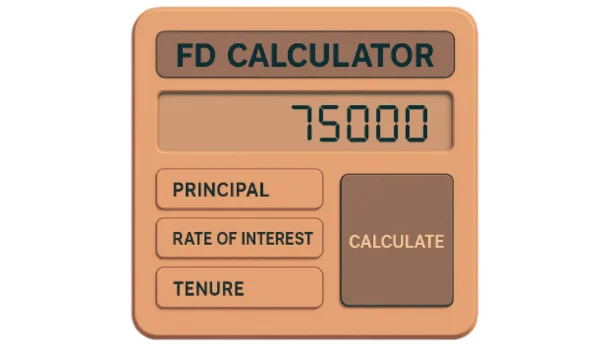
You can calculate the estimated maturity amount of your fixed deposit by entering the following details:
Deposit Amount: Enter the amount you want to invest in the FD.
Interest Rate: Enter the annual interest rate offered on the FD.
Tenure: Enter the period for which you want to keep the deposit.
Compounding Frequency: Select the applicable compounding frequency, such as quarterly, depending on the FD terms.
The calculator can provide:
Maturity Amount: The estimated amount you will receive at maturity.
Total Interest: The estimated interest earned during the FD tenure.
Initial Deposit: The amount originally invested in the fixed deposit.
For example, if you invest Rs. 1,00,000 at an annual interest rate of 7% for 5 years with quarterly compounding, the maturity amount would be approximately Rs. 1,41,478. The estimated interest earned would be approximately Rs. 41,478.
The actual maturity amount may differ depending on the bank, applicable interest rate, compounding method, deposit type, and other terms.
What Is an FD Calculator?
An FD Calculator is an online financial tool used to estimate the maturity value and interest earned on a fixed deposit.
Instead of calculating compound interest manually, you can enter the deposit amount, interest rate, and tenure to get an approximate result.
FD calculators can be useful when comparing different investment amounts, interest rates, and tenures.
How Does an FD Calculator Work?
An FD calculator generally uses the principal amount, annual interest rate, compounding frequency, and investment period to estimate the maturity amount.
For a cumulative FD where interest is compounded periodically, the commonly used formula is:
A = P × (1 + R/N)^(N × T)
Where:
A = Maturity amount
P = Principal or initial deposit
R = Annual interest rate in decimal form
N = Number of times interest is compounded per year
T = Investment tenure in years
For example, if the interest rate is 7%, it is represented as 0.07 in the formula.
Banks may follow specific calculation and interest-crediting methods according to the terms of the deposit, so the actual maturity amount should be confirmed with the respective bank or financial institution.
FD Calculation Example
Suppose you invest Rs. 1 lakh in a fixed deposit at an annual interest rate of 7% for 5 years, with quarterly compounding.
Initial Deposit: Rs. 1,00,000
Interest Rate: 7% per year
Tenure: 5 years
Compounding: Quarterly
Estimated Maturity Amount: Rs. 1,41,478
Estimated Interest Earned: Rs. 41,478
This is an illustrative calculation. Actual FD returns may vary according to the applicable interest rate and deposit terms.
FD Maturity Amount for Different Deposit Amounts
The following are illustrative maturity amounts assuming an annual interest rate of 7% and a 5-year tenure with quarterly compounding.
Rs. 50,000 deposit: Approximately Rs. 70,739
Rs. 1 lakh deposit: Approximately Rs. 1,41,478
Rs. 2 lakh deposit: Approximately Rs. 2,82,956
Rs. 5 lakh deposit: Approximately Rs. 7,07,391
Rs. 10 lakh deposit: Approximately Rs. 14,14,782
These figures are estimates and actual maturity values can vary depending on the applicable FD rate and bank terms.
Factors That Affect FD Returns
- Deposit Amount
The amount invested in the FD directly affects the maturity value. A larger deposit generally generates more interest when the interest rate and tenure remain the same.
- Interest Rate
The interest rate determines how much interest your deposit can earn. A higher rate generally results in a higher maturity amount.
- Investment Tenure
The duration of the FD affects the total interest earned. A longer tenure can result in greater interest earnings, although the applicable rate may vary depending on the deposit period.
- Compounding Frequency
Interest on cumulative fixed deposits may be compounded at specified intervals. The compounding frequency can affect the final maturity amount.
- Type of FD
Banks offer different types of fixed deposits. Cumulative FDs generally accumulate interest until maturity, while non-cumulative FDs may provide periodic interest payouts.
The calculation method can therefore differ depending on the type of deposit.
Cumulative FD vs Non-Cumulative FD
The main difference is how interest is paid.
In a cumulative FD, interest is generally accumulated and paid along with the principal at maturity.
In a non-cumulative FD, interest is paid at regular intervals such as monthly, quarterly, half-yearly, or annually, depending on the deposit terms.
A cumulative FD may be useful for someone looking for a lump-sum maturity amount, while a non-cumulative FD can provide periodic interest income.
FD Calculator for Senior Citizens
Banks generally offer different interest rates for senior-citizen fixed deposits, subject to their applicable terms.
If a senior citizen receives a higher interest rate than the standard FD rate, the maturity amount may also be higher for the same deposit amount and tenure.
For example, if a regular customer receives an interest rate of 7% while an eligible senior citizen receives 7.5%, the maturity amount will be different.
The exact rate and eligibility criteria depend on the bank and deposit product.
FD Interest Calculation
Suppose you invest Rs. 5 lakh in an FD for 3 years at an annual interest rate of 7%.
The actual maturity amount will depend on whether the FD is cumulative or non-cumulative and how the bank compounds and pays interest.
For a cumulative FD, the interest is generally reinvested during the deposit period and paid at maturity.
For a non-cumulative FD, interest is paid at the selected intervals instead of being accumulated until maturity.
Therefore, investors should check the specific FD terms before calculating expected returns.
Benefits of Using an FD Calculator
An FD Calculator can help you:
- Estimate your FD maturity amount.
- Calculate potential interest earnings.
- Compare different deposit amounts.
- Compare different FD tenures.
- Compare different interest rates.
- Plan your savings goals.
- Understand the potential impact of compounding.
- Estimate how much you may receive at maturity.
It can also make it easier to compare FD options offered by different banks, provided you use the applicable interest rates and terms for each deposit.
FD Calculator vs RD Calculator
An FD and RD calculator are used for different types of deposits.
An FD Calculator is used when you invest a lump sum amount at one time.
An RD Calculator is used when you make regular deposits, usually every month, for a predetermined period.
For example, investing Rs. 5 lakh at one time would generally be evaluated using an FD Calculator, while depositing Rs. 10,000 every month would generally require an RD Calculator.
FD Taxation in India
Interest earned from a fixed deposit is generally taxable according to the applicable income-tax rules.
Tax Deducted at Source (TDS) may also apply when the interest paid or credited crosses the applicable threshold and the relevant conditions are satisfied.
The tax treatment can depend on factors such as the type of deposit, amount of interest, investor status, and prevailing tax rules.
Therefore, investors should consider both the interest rate and applicable tax implications when comparing FD returns.
Frequently Asked Questions
What is an FD Calculator?
An FD Calculator is a financial tool that estimates the interest earned and maturity amount of a fixed deposit based on the deposit amount, interest rate, tenure, and applicable compounding method.
How much will Rs. 1 lakh become in an FD?
At an illustrative interest rate of 7% per year for 5 years with quarterly compounding, Rs. 1 lakh may grow to approximately Rs. 1,41,478.
The actual maturity amount depends on the bank’s applicable interest rate and deposit terms.
Is FD interest compounded?
For cumulative fixed deposits, interest is generally compounded according to the bank’s specified calculation frequency. The exact method can vary by deposit product.
Which is better, cumulative or non-cumulative FD?
They serve different purposes. A cumulative FD generally pays the accumulated amount at maturity, while a non-cumulative FD provides periodic interest payouts. The suitable option depends on whether you want regular income or a lump-sum maturity amount.
Does FD interest attract tax?
Yes, FD interest is generally taxable according to applicable income-tax rules. TDS may also apply when the relevant conditions and thresholds are met.
Can I calculate senior citizen FD returns?
Yes. You can calculate senior citizen FD returns by entering the interest rate applicable to the eligible senior-citizen deposit. Since rates can differ between banks, use the rate offered by the specific bank.
Does an FD Calculator show the exact maturity amount?
An FD Calculator provides an estimate based on the information entered. The actual maturity amount may differ depending on the bank’s calculation method, applicable interest rate, compounding frequency, deposit terms, and other conditions.
Conclusion
An FD Calculator is a useful tool for estimating the maturity amount and interest earned on a fixed deposit. By entering the deposit amount, interest rate, tenure, and compounding details, you can understand the potential growth of your investment.
Before opening an FD, compare the applicable interest rate, tenure, premature withdrawal rules, taxation, and other terms offered by the bank or financial institution. This can help you make a more informed decision about your fixed deposit investment.
